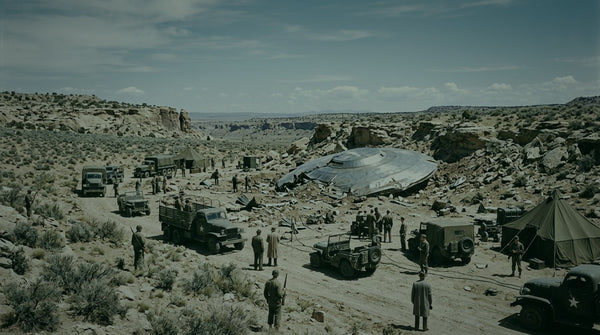
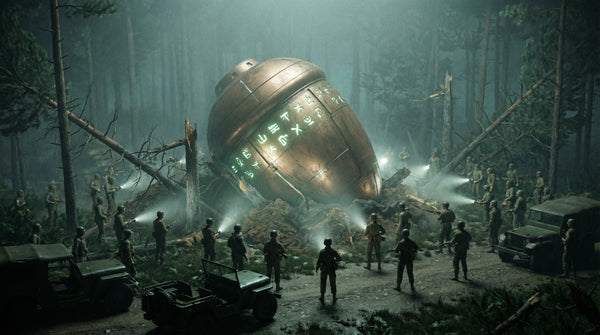
On July 8, 1947, the Roswell Army Air Field (RAAF) public information office issued a press release stating they had recovered a "flying disc." Within 24 hours, the story was officially retracted, and the debris was identified as a conventional weather balloon. This sudden reversal sparked a controversy that has endured for over 75 years — making Roswell the most infamous and debated UFO incident in recorded history.
| // KEY FACTS AT A GLANCE | |
|---|---|
| Primary Investigator | Major Jesse Marcel, RAAF Intelligence Officer |
| Date of Incident | Circa July 4, 1947 |
| Discovery Location | Foster Ranch, near Corona, New Mexico |
| Initial Official Report | Recovery of a 'flying disc' |
| Official Retraction | Weather balloon (later: Project Mogul) |
| Key Witnesses | Jesse Marcel, Glenn Dennis, Frankie Rowe, Walter Haut |
| Alleged Recovery | Non-terrestrial craft and alien bodies |
| Declassified Evidence | Project Mogul reports, FBI teletypes, GAO report |
| Air Force Reports | 1994 & 1997 official investigations |
| Current Status | Officially explained; widely disputed |
// The Discovery: Mac Brazel and the Debris Field
In early July 1947, rancher W.W. "Mac" Brazel discovered an extensive debris field scattered across his property on the J.B. Foster Ranch, approximately 75 miles north of Roswell. The material was unlike anything he had encountered in decades of working the land. He described lightweight, metallic-like fragments, some with I-beam structures bearing strange, purplish hieroglyphic-like markings that he could not identify.
The material possessed properties that defied conventional explanation. Witnesses described foil-like sheets that, when crumpled, would immediately return to their original flat configuration. The I-beams were extraordinarily light yet could not be bent, cut, or burned. Brazel collected samples and reported the find to Chaves County Sheriff George Wilcox, who in turn contacted the RAAF.
"We found a bunch of stuff that looked like tin foil, but it was different. You could crumple it up, and it would straighten itself right back out. We also found some little beams with some kind of writing on them, like purple hieroglyphics. It wasn't any kind of writing we had ever seen before."
— W.W. "Mac" Brazel, rancher, Foster Ranch
// Major Marcel and the Military Response
Major Jesse Marcel, the intelligence officer from the RAAF, was dispatched to investigate Brazel's report. He accompanied Brazel to the debris field and was immediately struck by what he found. In a 1979 interview — given years after his retirement, when he had nothing to gain from fabrication — Marcel stated unequivocally that the material he handled was "not of this Earth."
Marcel described the foil-like material as incredibly thin yet impossibly strong. He attempted to bend it, burn it, and cut it. None of these methods left any mark. The I-beams, he said, were covered in symbols that resembled no known alphabet or language. He loaded the debris into his car and drove through the night to the RAAF base, stopping at his home to show his wife and son what he had found — a decision that would later provide additional corroborating testimony.
The following morning, on July 8, 1947, RAAF base commander Colonel William Blanchard authorized the release of the now-famous press statement. The Roswell Daily Record ran the headline: "RAAF Captures Flying Saucer on Ranch in Roswell Region." The story was picked up by wire services and broadcast internationally within hours.
// The Retraction: General Ramey's Press Conference
The retraction came with remarkable speed. Within 24 hours of the initial announcement, Brigadier General Roger Ramey, commander of the Eighth Air Force at Fort Worth Army Air Field in Texas, held a press conference presenting debris that he identified as the remains of a standard weather balloon with a radar reflector. Photographs were taken of Marcel posing with the weather balloon material — images that would be used for decades to dismiss his account.
Marcel maintained until his death that the material in those photographs was not what he had recovered from the Foster Ranch. He believed the weather balloon debris had been substituted for the actual material before the press conference, and that he had been ordered to go along with the cover story. His son, Jesse Marcel Jr., who had handled the original debris as a child, corroborated his father's description in detail in multiple interviews over the following decades.
"It was not a weather balloon. It was not any kind of balloon. It was not anything I had ever seen before, and I was pretty familiar with all the equipment the Air Force was using at the time. It was something else."
— Major Jesse Marcel, RAAF Intelligence Officer, 1979 interview
// The Bodies: Witness Testimony
The debris field was not the only element of the Roswell incident that witnesses described. Over the years, numerous individuals came forward with accounts of a second crash site and the recovery of non-human bodies. These testimonies, many given on deathbeds or under conditions that offered no personal benefit, form a consistent and troubling pattern.
Glenn Dennis, a mortician working for Ballard Funeral Home in Roswell in 1947, claimed he received calls from the RAAF mortuary officer asking about the availability of child-sized hermetically sealed caskets and inquiring about procedures for preserving bodies that had been exposed to the elements. When he drove to the base hospital to deliver an injured airman, he was confronted by military personnel and warned in explicit terms to keep quiet about what he had seen and heard.
Frankie Rowe, whose father served as a firefighter in Roswell, described seeing a non-human body at the crash site. She and her family were subsequently visited by military personnel who made clear, in language she described as threatening, that the family was to remain silent about what they had witnessed. Similar accounts of intimidation were reported by multiple witnesses across the Roswell area in the days following the incident.
"They told us that if we ever told anybody about what we saw, we would be taken out to the desert and nobody would ever find us again."
— Frankie Rowe, witness, Roswell, New Mexico
// Project Mogul: The Official Explanation
In 1994, responding to a congressional inquiry initiated by Representative Steven Schiff of New Mexico, the U.S. Air Force released a report titled "The Roswell Report: Fact vs. Fiction in the New Mexico Desert." The report concluded that the debris recovered at the Foster Ranch was from a classified government program called Project Mogul — a top-secret initiative that used high-altitude balloon trains equipped with acoustic sensors to monitor Soviet nuclear tests.
The Project Mogul explanation accounts for some of the unusual material properties described by witnesses. The balloon trains used specialized radar reflectors made from materials that were not in common use, and the classification of the program would explain the military's desire to suppress information about the recovery. A follow-up report in 1997, "The Roswell Report: Case Closed," addressed the persistent accounts of alien bodies by attributing them to distorted memories of crash test dummies used in high-altitude parachute experiments conducted in the 1950s.
Critics of the Project Mogul explanation point to several significant problems. The crash test dummy experiments described in the 1997 report did not begin until 1953 — six years after the Roswell incident. The Air Force's suggestion that witnesses confused events separated by years strains credibility. Additionally, Project Mogul balloons, while classified, were composed of standard materials available at the time. None of these materials possessed the indestructible, shape-memory properties that multiple independent witnesses described with remarkable consistency.
The FBI's own records complicate the official narrative. A teletype sent from the Dallas Field Office to FBI Director J. Edgar Hoover on July 8, 1947 — the same day as the initial press release — describes the recovery of a "flying disc" and notes that the Army had informed the FBI that the object was "hexagonal in shape" and "suspended from a balloon by a cable." This description does not match a standard weather balloon, and the teletype's existence was not acknowledged in the official Air Force reports.
// The Congressional Investigation and FOIA Documents
The 1994 General Accounting Office (GAO) investigation, requested by Representative Schiff, produced findings that added further complexity to the official record. The GAO discovered that outgoing messages from the RAAF for the period covering the Roswell incident had been destroyed — a violation of federal record-keeping regulations. The destruction of these records, which should have been preserved for decades, was never explained.
FOIA requests over the subsequent years have produced a collection of documents that, while individually inconclusive, collectively suggest a level of government interest in the Roswell incident that goes beyond what a weather balloon recovery would warrant. The FBI's Vault — its online repository of declassified documents — contains multiple files related to Roswell, including the 1947 teletype and subsequent communications that reference the recovery of "flying discs" in terms that do not align with the weather balloon narrative.
// The Broader Significance: Roswell in the Age of UAP Disclosure
The Roswell incident has taken on renewed significance in the context of recent UAP disclosure developments. In 2023, former intelligence official David Grusch testified before Congress that the U.S. government has been conducting a multi-decade program of crash retrieval and reverse engineering of non-human craft. When asked specifically about Roswell, Grusch declined to comment on specific cases but confirmed that crash retrieval programs had been active since the 1940s.
The Roswell incident, if it involved the recovery of non-human technology, would represent the foundational event of that program — the moment when the United States government first came into possession of materials and, potentially, biological specimens of non-terrestrial origin. Whether or not that is what happened in the New Mexico desert in July 1947, the question has moved from the margins of fringe culture to the floor of the United States Congress.
// Why Roswell Matters to Collectors
The Roswell incident produced the most iconic image in UFO history: the classic grey alien, the disc-shaped craft, the desert crash. These images have permeated popular culture so thoroughly that they have become shorthand for the entire phenomenon. But for serious collectors, Roswell represents something more specific — the first documented case of a government recovery operation, the first cover-up, and the first deathbed testimonies from credible witnesses who had nothing to gain from their disclosures.
At UFODesigns3D, our Roswell-inspired models are built from the documented descriptions of the craft's shape, dimensions, and surface characteristics as reported by witnesses who handled the actual material. The grey alien figurines in our collection are derived from the consistent physical descriptions provided by Glenn Dennis, Frankie Rowe, and other Roswell witnesses — not from Hollywood interpretations.
// Conclusion: The Case That Won't Close
Seventy-five years of official explanations have not resolved the Roswell incident. The Project Mogul theory accounts for some of the evidence but fails to explain the witness accounts of non-human bodies, the destruction of official records, the FBI teletype, or the systematic intimidation of civilian witnesses. The crash test dummy explanation requires witnesses to have confused events separated by six years.
What remains is a body of testimony from credible individuals — a military intelligence officer, a mortician, a firefighter's daughter, and dozens of others — who described, consistently and independently, an event that the official record cannot fully account for. Whether the truth of Roswell is ultimately disclosed through congressional testimony, FOIA releases, or the deathbed confessions of those who still carry the secret, the case that began with a press release in 1947 remains, by any measure, unresolved.
// RECOVERED ARTIFACT
The entities from this case file exist as precision 3D-printed replicas — modeled from the same witness testimony and reference material you just read.
Examine the Roswell Grey Alien Bust →
Examine the Roswell Grey Alien Figurine →
Examine the Roswell Grey Alien Headphone Stand →
// OWN A PIECE OF THE LORE
The being recovered from the New Mexico desert — cast from the original eyewitness descriptions.