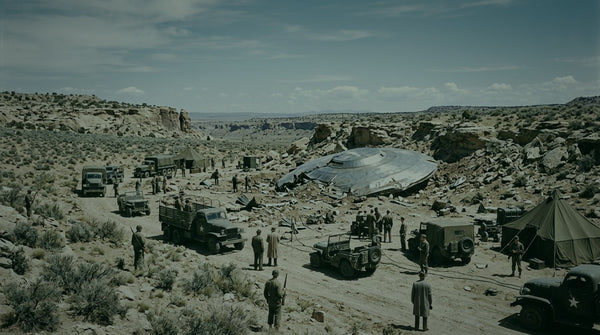
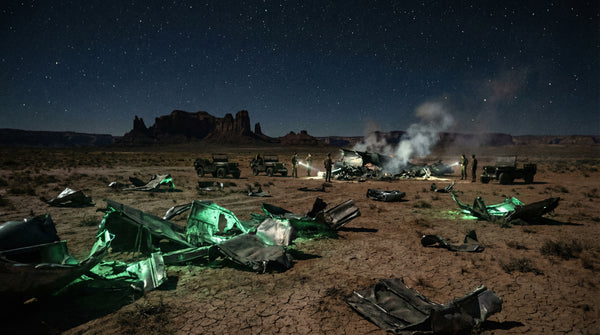
On the evening of December 9, 1965, a fireball blazed across the skies of six U.S. states and parts of Canada, witnessed by thousands of people from Michigan to New York. It was bright enough to be seen in daylight, and it left a smoke trail that lingered for minutes. When it came down in the woods near the small village of Kecksburg, Pennsylvania, what witnesses found on the ground was not a meteor. It was a structured, metallic object — acorn-shaped, bronze in color, and bearing markings that no one could read. The military arrived within hours and removed it. Then they denied it had ever existed.
| // KEY FACTS AT A GLANCE | |
|---|---|
| Date of Incident | December 9, 1965 |
| Location | Kecksburg, Westmoreland County, Pennsylvania |
| Sighting Corridor | Michigan, Ohio, Pennsylvania, New York, Ontario, Quebec |
| Object Description | Bronze acorn-shaped craft, 12 ft long, 8 ft wide |
| Distinctive Feature | Hieroglyphic-like markings around the base |
| Military Response | U.S. Army cordoned off the area; object removed on flatbed |
| Official Explanation | Meteor (later: Soviet satellite GE-3) |
| Key Witnesses | James Romansky, John Murphy (WHJB radio), multiple locals |
| NASA FOIA Lawsuit | Filed by Sci-Fi Channel, 2003; documents found missing |
| Comparison | Frequently called 'Pennsylvania's Roswell' |
// The Fireball: A Six-State Spectacle
The object that crossed the sky on December 9, 1965 was no ordinary meteor. Eyewitnesses across a corridor stretching from Detroit, Michigan to western Pennsylvania described a brilliant fireball that moved with a controlled, deliberate trajectory — slowing as it descended rather than accelerating as a typical meteorite would. It was visible in broad daylight, it left a persistent smoke trail, and multiple witnesses reported hearing a sonic boom or low rumble as it passed overhead.
Seismograph stations in the region recorded a minor earth tremor consistent with an impact in western Pennsylvania. The United States Geological Survey placed the impact zone in the vicinity of Kecksburg, a rural community of approximately 100 households in Westmoreland County, southeast of Pittsburgh. Local residents who ran toward the impact site reported finding a fresh gouge in the earth in the woods — and at the end of that gouge, a metallic object unlike anything they had ever seen.
"It wasn't a meteor. Meteors don't slow down. Meteors don't make controlled turns. Whatever this was, it was under some kind of guidance. It came down slow and deliberate, like it was trying to land."
— Eyewitness account, Westmoreland County, December 1965
// The Object: Acorn-Shaped, Bronze, and Marked
The witnesses who reached the crash site before the military cordoned off the area described the object in remarkably consistent terms. It was roughly the size of a Volkswagen Beetle — approximately 12 feet long and 8 feet wide — and shaped like an acorn or a rounded bell. The surface was a dull bronze or copper color, smooth and metallic. It appeared undamaged, as if it had landed deliberately rather than crashed.
The most distinctive and frequently cited feature was a band of markings around the base of the object. Multiple witnesses described these markings as resembling hieroglyphics or some form of unknown script — geometric symbols arranged in a repeating pattern that circled the entire lower rim of the craft. The markings were not painted on; they appeared to be part of the object's surface structure, either etched or embossed into the metal itself.
James Romansky, a volunteer firefighter who was among the first responders to reach the site, provided the most detailed and consistent description of the object over the following decades. He described the acorn shape, the bronze surface, and the hieroglyphic markings in multiple interviews spanning more than 40 years — with a consistency that investigators found compelling.
"It was definitely a structured craft. It was bronze-colored, shaped like an acorn, and around the base there were markings — like hieroglyphics, but not Egyptian. Something I had never seen before and have never seen since. It was not a meteor. It was not a satellite. It was something else entirely."
— James Romansky, volunteer firefighter, Kecksburg, Pennsylvania
// The Military Response: Rapid, Organized, and Silent
What happened next is, in many ways, more significant than the object itself. Within hours of the impact, U.S. Army personnel arrived in Kecksburg in force. They cordoned off the woods, turned back civilian witnesses and local law enforcement, and established a perimeter around the crash site. Local residents who had already reached the object were escorted out and warned not to discuss what they had seen.
John Murphy, the news director of local radio station WHJB, was one of the first journalists on the scene. He managed to reach the impact site before the military cordon was fully established and later described seeing the object. He subsequently prepared a radio documentary about the incident — a documentary that was never broadcast. Murphy told colleagues that military officials had visited the station and confiscated portions of his recorded material. The documentary was shelved. Murphy died in a hit-and-run accident in 1969, before he could fully tell his story.
In the early hours of December 10, witnesses reported seeing a flatbed military truck leaving the area with a large object covered by a tarpaulin. The object beneath the tarp was described as acorn-shaped and approximately the right size to be what had been seen in the woods. The truck was observed heading in the direction of Wright-Patterson Air Force Base in Ohio — the same facility repeatedly named in connection with the storage of recovered UAP materials.
// The Official Explanations: Meteor, Then Satellite
The official response to the Kecksburg incident evolved over time in a manner that itself raises questions. The initial explanation was that the fireball was a meteor that had burned up before reaching the ground. This explanation was difficult to sustain given the number and credibility of the witnesses, the seismograph data, and the documented military response. The official story was subsequently revised — in later years, NASA and other agencies suggested the object may have been a Soviet satellite, specifically the Kosmos 96 probe.
The Soviet satellite explanation has been examined and largely rejected by independent researchers. U.S. Space Command's own orbital tracking data indicates that Kosmos 96 re-entered the atmosphere over Canada at approximately 3:18 AM on December 9, 1965 — more than nine hours before the Kecksburg fireball was observed at approximately 4:45 PM that same afternoon. The two events cannot be the same object. Additionally, the Kosmos 96 probe was a spherical Venus lander that bore no resemblance to the acorn-shaped, hieroglyphic-marked object described by Kecksburg witnesses.
// The NASA FOIA Battle
In 2003, the Sci-Fi Channel funded a legal effort to compel NASA to release documents related to the Kecksburg incident. The lawsuit sought internal NASA records that researchers believed existed based on references in other declassified documents. NASA acknowledged that relevant documents had existed but stated they had been lost or misplaced. A federal judge ordered NASA to conduct a more thorough search — the results were similarly inconclusive, producing documents that referenced the Kecksburg incident in ways suggesting a more significant internal investigation than NASA had publicly acknowledged, while failing to provide the substantive records that would resolve the central questions.
// The Nazi Bell Connection: A Contested Theory
Among the more provocative theories surrounding the Kecksburg object is the suggestion that the acorn shape and hieroglyphic markings are consistent with descriptions of a classified Nazi Germany project known as "Die Glocke" — The Bell. According to documents and testimonies that emerged after World War II, Die Glocke was a bell-shaped experimental device developed by the SS at a facility in occupied Poland, reportedly involving exotic propulsion or energy technology. The theory holds that Die Glocke was evacuated from Germany at the end of the war and that the Kecksburg object represented either the original device or a derivative technology. This theory remains highly contested, but the physical description of the Kecksburg object is consistent enough with the Die Glocke descriptions that it has proven difficult to dismiss entirely.
// Kecksburg in the Age of UAP Disclosure
The Kecksburg incident has taken on renewed relevance in the context of recent congressional UAP hearings. David Grusch's 2023 testimony before the House Oversight Committee described a multi-decade program of crash retrieval and reverse engineering that began in the 1940s and continued through subsequent decades. If such a program existed, the Kecksburg recovery of 1965 would represent one of its documented operational moments — a case where the retrieval machinery was deployed rapidly, effectively, and with a level of organization that suggests prior experience and established protocols.
// Why Kecksburg Matters to Collectors
The Kecksburg object is unique in the UFO canon for its shape. While most famous UFO cases involve disc-shaped or triangular craft, the Kecksburg acorn is a distinct and precisely described form — one that appears in no other major UFO case and that has no obvious terrestrial analogue. Its bronze surface, its hieroglyphic markings, and its apparent structural integrity make it one of the most visually distinctive objects in the documented UFO record.
At UFODesigns3D, our Kecksburg Acorn replica is built from the detailed descriptions provided by James Romansky and other witnesses, cross-referenced against the illustrations that Romansky worked with artists to produce over the following decades. The acorn profile, the base markings, the surface texture — every element is derived from the most consistent and credible witness accounts available.
// Conclusion: Pennsylvania's Roswell
The Kecksburg incident is not a story built on a single witness or a blurry photograph. It is a story built on dozens of consistent eyewitness accounts, seismograph data, a documented military response, a confiscated radio documentary, missing federal records, and a flatbed truck that left a Pennsylvania forest in the middle of the night carrying something that has never been officially identified.
The official explanations — meteor, Soviet satellite — do not survive contact with the evidence. What remains is a structured, metallic, acorn-shaped object with unknown markings that was recovered by the U.S. military, transported to an undisclosed location, and erased from the official record with a thoroughness that speaks to the seriousness with which those responsible regarded what they had found.
Pennsylvania's Roswell did not produce the same volume of testimony as its New Mexico counterpart. But what it produced was arguably more precise: a single, well-described object, seen by multiple credible witnesses at close range, recovered in a documented military operation, and subsequently disappeared into the same classified infrastructure that has absorbed every other piece of non-human technology that the United States government has chosen not to acknowledge.
// RECOVERED ARTIFACT
The craft from this case file exists as a precision 3D-printed replica — modeled from the same witness testimony and reference material you just read. Examine the Kecksburg Acorn UFO →
// OWN A PIECE OF THE LORE
The acorn-shaped object that soldiers carried away under cover of darkness — faithfully reproduced.