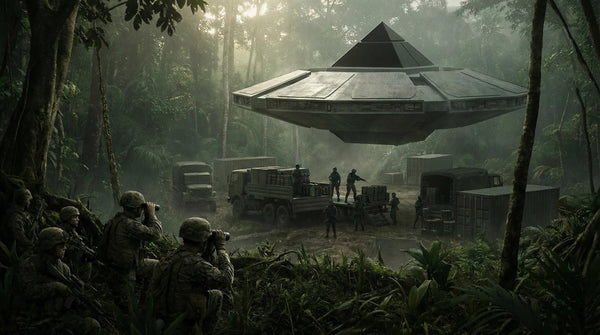
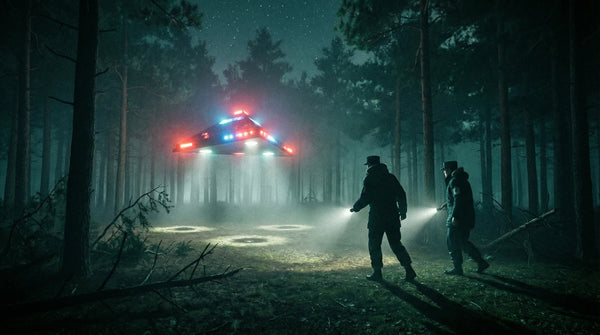
For decades, thousands of witnesses across the globe have reported sightings of massive, silent, triangular aircraft — often with lights at each corner and a central, glowing orb. These "black triangles" are one of the most persistent and well-documented phenomena in UFO research. But here's what most people get wrong: they treat every black triangle sighting as the same craft. They're not. The evidence points to at least two distinct platforms — and they are as different from each other as an F-117 Nighthawk is from a flying saucer.
// TR-3A vs TR-3B: Two Different Aircraft
The confusion is understandable. Both are black. Both are triangular. Both are classified. But the similarities end there. The NSA, NRO, CIA, and USAF have allegedly used overlapping nomenclature — TR-3, TR-3A, TR-3B, Tier 2, Tier 3, Tier 4, with suffixes like Plus or Minus — to deliberately obscure the fact that each designator refers to a different aerospace vehicle. As one researcher put it: a TR-3B is as different from a TR-3A as a banana is from a grape.
| TR-3A "Black Manta" | TR-3B "Astra" | |
|---|---|---|
| Type | Subsonic stealth tactical reconnaissance | Anti-gravity aerospace platform |
| Shape | Sharp angular triangle, flat profile | Rounded corners, thicker with central dome/bulge |
| Propulsion | Conventional jet engines | Magnetic Field Disruptor (MFD) + 3 multimode thrusters |
| Underside | Flat, featureless stealth surface | Circular plasma ring (MFD) protruding from center |
| Corner Features | Clean stealth edges | Bright lights / thruster housings at each vertex |
| First Reported | ~1991, Aviation Week / Popular Mechanics | ~1998, Edgar Fouché presentation |
| Alleged Role | Laser designation for F-117s in Desert Storm | High-altitude recon, indefinite loiter, Mach 9+ capable |
| Program | Aurora Program (conventional black project) | Aurora Program / SDI (exotic technology) |
| Status | Possibly retired or evolved into newer platforms | Allegedly operational since early 1990s |
The distinction matters. When a witness in Belgium in 1989 describes a massive, silent craft with rounded corners and a glowing central light that accelerates from hovering to 1,800 km/h in under a second — that's the TR-3B Astra. When aviation spotters in the early 1990s describe a sharp-edged triangular aircraft flying alongside F-117s in the Gulf War — that's the TR-3A Black Manta. Same family. Completely different technology.
// The TR-3A Black Manta: The Conventional One
The TR-3A is the craft that started the black triangle conversation. Aviation watchers first whispered about it in 1991, when industry publications described a triangular, stealthy recon craft operating alongside F-117 Nighthawks during Operation Desert Storm. The alleged role: providing laser designation for the Nighthawk's bombs, though skeptics noted that the F-117 already carried its own laser designator.
The TR-3A is generally believed to have been developed by Northrop under the USAF's classified programs. It was said to be subsonic, radar-evading, and designed purely for tactical reconnaissance — a flying camera platform that could loiter over hostile territory without being detected. There was nothing exotic about its propulsion. It was a conventional aircraft, just one that the government never acknowledged.
The TR-3A's angular, sharp-edged silhouette is consistent with stealth design principles: flat surfaces angled to deflect radar returns, no curves to create reflections, edges designed to scatter rather than bounce signals back to the source. It looks like what it probably was — a product of the same stealth engineering lineage that produced the F-117 and B-2 Spirit.
Whether the TR-3A was ever actually built and flown remains officially unconfirmed. But it is worth noting that "TR-3" may refer to a Technical Refresh of an existing program — a designation that would place it squarely within conventional defense procurement, not exotic technology development.
// The TR-3B Astra: The Exotic One
The TR-3B is a different animal entirely. Code named "Astra," the TR-3B is the platform that Edgar Fouché described in his 1998 presentation — a triangular nuclear-powered aerospace vehicle that uses a device called the Magnetic Field Disruptor to partially neutralize gravity. Where the TR-3A was a stealth spy plane, the TR-3B is alleged to be something that shouldn't exist.
The physical description is distinct from the TR-3A in every way that matters. According to witnesses and Fouché's account, the TR-3B has:
- Rounded, softened corners — not the sharp angular edges of a stealth aircraft
- A circular, protruding disc on the underside — the Magnetic Field Disruptor ring, filled with pressurized mercury plasma
- Bright lights at each vertex — the three multimode thrusters that provide conventional propulsion once the MFD has reduced the craft's effective mass
- A central glowing light — described as pulsing amber or red, surrounded by the three corner lights
- A thinner profile than most artistic interpretations suggest, according to witnesses who claim firsthand knowledge
The MFD is the core of the TR-3B's alleged capability. According to Fouché, mercury-based plasma is pressurized to 250,000 atmospheres at a temperature of 150 degrees Kelvin and accelerated to 50,000 RPM within a circular ring that surrounds the crew compartment. This process creates a superconducting vortex that disrupts the local gravitational field, reducing the craft's effective mass by up to 89 percent.
Fouché was explicit on one point: the TR-3B is not anti-gravity in the science fiction sense. It doesn't repel gravity — it disrupts the gravitational field's effect on the craft's mass. With 89 percent of its mass effectively neutralized, the three conventional rocket engines at each corner only need to propel 11 percent of the craft's actual weight. That's how it achieves performance that appears to violate physics — the physics aren't being violated, they're being calculated against the wrong mass figure.
// The Belgian UFO Wave: The Definitive Case
The most significant and rigorously documented series of black triangle sightings occurred in Belgium between November 1989 and April 1990. Over a period of several months, an estimated 13,500 people filed official reports with Belgian authorities describing large, silent, low-flying triangular craft. The witnesses included not only civilians but military personnel, police officers, and air traffic controllers — individuals whose professional credibility and observational training make their accounts particularly difficult to dismiss.
The sightings followed a consistent pattern. The craft were described as large equilateral triangles, typically with three bright lights at each corner and a central rotating light. They moved at extremely low altitudes and speeds, sometimes hovering in place for extended periods. Despite their apparent mass, they produced no sound — a characteristic that no conventional aircraft of the period could replicate. When they did accelerate, they did so with a speed and directional change capability that witnesses described as instantaneous.
"The object was enormous. It was moving very slowly, almost hovering, and it was completely silent. The lights at the corners were brilliant white, and the central light was rotating. Nothing in our inventory could do what this thing was doing."
— Belgian police officer, official report, November 1989
The description — rounded form, bright corner lights, central rotating light, silent hover, instantaneous acceleration — is consistent with the TR-3B Astra profile, not the TR-3A. If these craft were American, they were not the conventional stealth variant.
// The F-16 Intercept: March 30, 1990
The Belgian UFO wave reached its most dramatic point on the night of March 30, 1990. Belgian Air Force radar stations detected an unidentified object over the country, and two F-16 fighters were scrambled to intercept. The pilots made radar lock on the object on three separate occasions. Each time, the object performed maneuvers that the pilots and ground controllers described as physically impossible for any known aircraft.
The object accelerated from approximately 280 kilometers per hour to over 1,800 kilometers per hour in seconds — a rate of acceleration that would kill a human pilot. It then descended from 10,000 feet to 500 feet in the same timeframe, before climbing again. The radar lock was broken each time by the object's evasive maneuvers. The entire engagement was recorded on the F-16s' onboard computers, and the data was subsequently analyzed by Belgian Air Force officials and released to the public — an unusual act of transparency that lent the incident significant credibility.
"The acceleration was beyond anything we have in our inventory. The object went from 280 km/h to 1,800 km/h in less than a second. No aircraft we know of can do that. No aircraft we know of can survive doing that."
— Major General Wilfried De Brouwer, Belgian Air Force, press conference, 1990
Major General Wilfried De Brouwer, the Belgian Air Force officer who oversaw the investigation, held a press conference in which he presented the radar data and acknowledged that the Belgian military had been unable to identify the objects. He explicitly stated that the objects were not conventional aircraft, weather phenomena, or laser projections. If the MFD reduces the craft's effective mass by 89 percent as Fouché claims, the g-forces experienced by the crew would also be reduced by 89 percent — making the Belgian radar data's implied accelerations survivable.
// The Aurora Program and Black Budget Origins
The most widely accepted hypothesis among serious researchers is that both the TR-3A and TR-3B are products of the United States' classified aerospace development programs, collectively referred to as "black projects" and funded through the black budget — a portion of the defense budget that is not subject to public disclosure or congressional oversight in the conventional sense.
The Aurora Program, first referenced in a 1985 Pentagon budget document that was accidentally declassified, is believed to be the umbrella program under which several classified aircraft were developed during the 1980s and 1990s. The TR-3A, as a conventional stealth aircraft, would have been a natural evolution of the same engineering that produced the F-117. The TR-3B, however, represents something fundamentally different — technology that may connect to the Strategic Defense Initiative (SDI), the Reagan-era "Star Wars" program.
The SDI's classified components, funded through channels that were deliberately obscured from public scrutiny, provided the financial and institutional infrastructure for research into exotic propulsion and energy technologies. If the TR-3B's propulsion system incorporates technology derived from non-terrestrial sources — as Bob Lazar's account of the S4 facility suggests was possible — then the SDI program would have provided both the funding mechanism and the security classification structure necessary to develop and deploy such technology without public knowledge.
// The Hudson Valley Wave and North American Sightings
The Belgian wave was not the first major cluster of black triangle sightings. Between 1982 and 1986, the Hudson Valley region of New York and Connecticut experienced a sustained wave of sightings that drew significant media attention and produced thousands of witness reports. The objects described in the Hudson Valley wave were consistent with those reported in Belgium: large, silent, triangular craft with multiple lights, capable of hovering and performing maneuvers that defied conventional aerodynamics.
Researcher J. Allen Hynek, the former U.S. Air Force scientific consultant on UFO investigations who had spent decades as a skeptic, investigated the Hudson Valley sightings and concluded that the objects could not be explained by conventional aircraft, weather phenomena, or mass hallucination. His involvement lent the Hudson Valley wave a degree of scientific credibility that was unusual for UFO cases of the period.
Subsequent waves of black triangle sightings have been reported across North America, Europe, and Australia. The consistency of the descriptions across cultures, languages, and decades suggests that whatever is being observed is a real, physical phenomenon — not a cultural artifact or misidentification of conventional aircraft.
// The Phoenix Lights: The Most Witnessed Event
On the night of March 13, 1997, between 7:30 and 10:30 PM, thousands of people across the state of Arizona — and extending into Nevada and the Mexican state of Sonora — reported seeing a massive, V-shaped or triangular formation of lights moving silently across the sky. The event, which became known as the Phoenix Lights, is one of the most witnessed UAP events in history, with estimates of the number of witnesses ranging from several thousand to over ten thousand.
The object, or objects, were described as moving at low altitude, making no sound, and blocking out stars as they passed overhead — indicating a solid, physical structure rather than a formation of individual aircraft. The Arizona Air National Guard subsequently claimed that the lights were illumination flares dropped during a training exercise. Witnesses who observed the object directly overhead, rather than at a distance, rejected this explanation, noting that the flares were dropped hours after the initial sightings and in a different location.
Then-Governor Fife Symington initially mocked the sightings at a press conference, producing a staffer dressed in an alien costume. Years later, after leaving office, Symington publicly acknowledged that he had personally witnessed the object and that it was "otherworldly." His reversal, made with nothing to gain and considerable credibility to lose, is among the most significant witness recantations in the history of UAP research.
// The Salvatore Pais Patents: The Paper Trail
In 2016, the U.S. Navy filed a patent titled "Craft Using an Inertial Mass Reduction Device" — and the inventor was Dr. Salvatore Cezar Pais, a Navy scientist who had worked as a NASA graduate research fellow and an advanced concepts analyst with Northrop Grumman. Two additional patents followed, covering gravitational-wave generators and spacetime modification technology. The Navy confirmed spending at least $466,000 advancing Pais' work since 2017, and reports indicate he subsequently moved to the U.S. Space Force.
The proposed shape in the Pais patent bears a notable resemblance to the TR-3B. The technology described — inertial mass reduction through electromagnetic field manipulation — is conceptually aligned with what Fouché described as the Magnetic Field Disruptor nearly two decades earlier. Filing a patent does not prove a working craft exists, but it proves the U.S. government is investing real money in the exact type of technology that the TR-3B is alleged to use.
// Terrestrial Technology or Non-Human Origin?
The central question surrounding the TR-3B is whether it represents the apex of human aerospace engineering or something more fundamental — technology derived from non-terrestrial sources. The two hypotheses are not mutually exclusive. If the United States government recovered non-human craft at Roswell in 1947, or at any of the other crash sites that have been alleged by credible witnesses, then the TR-3B could represent the product of decades of reverse engineering conducted at facilities like the S4 installation described by Bob Lazar.
The timeline is suggestive. The first major black triangle sightings began in the early 1980s — approximately 35 years after the Roswell incident. If a reverse-engineering program began in the late 1940s, a 35-year development timeline to produce a flyable prototype is not implausible, particularly given the complexity of the technology involved. The Belgian wave of 1989–1990 would then represent the operational testing phase of a craft that had been under development for four decades.
// The Black Triangles in the UFODesigns3D Collection
The TR-3A and TR-3B represent two different chapters of the same story — the conventional stealth chapter and the exotic anti-gravity chapter. At UFODesigns3D, we believe collectors deserve models that reflect the actual distinction in the lore, not a one-size-fits-all triangle.
Our TR-3A Black Manta model captures the sharp, angular, radar-evading silhouette of the conventional stealth variant — the craft that aviation watchers first reported flying alongside F-117s in Desert Storm. Every edge is designed to scatter, not reflect. It's the black triangle as a military asset.
The TR-3B Astra — with its rounded corners, central MFD disc, and vertex thruster housings — is a fundamentally different craft. It's the black triangle as something that shouldn't be possible. The Astra model is coming soon.
Both models are built from the documented witness record and research literature — not from artistic interpretation.
// Conclusion: The Shadow in the Sky
The black triangle phenomenon remains one of the most compelling unresolved questions in aerospace and UAP research. The evidence is not a single witness account or a blurry photograph — it is a global pattern of consistent, documented sightings spanning four decades, including a military engagement that produced radar data released by a NATO member government.
Whether the TR-3A is a retired stealth platform or still flying, whether the TR-3B Astra is a product of human ingenuity or reverse-engineered non-terrestrial technology — these craft represent something that the official record cannot explain away. The black triangles are real. They have been seen by tens of thousands of credible witnesses on multiple continents. They have been tracked on military radar. They have been engaged by fighter aircraft. And they remain, officially, unidentified.
That is not a mystery that will be resolved by dismissal. It is a mystery that demands investigation — and, for those who understand what the evidence suggests, it is a mystery that deserves to be remembered.
// OWN THE BLACK TRIANGLES

COMING SOON
TR-3B
ASTRA
Rounded corners. Central MFD disc.
The exotic variant.
TR-3B Astra – Coming Soon
Anti-gravity. Magnetic Field Disruptor. A different craft entirely.