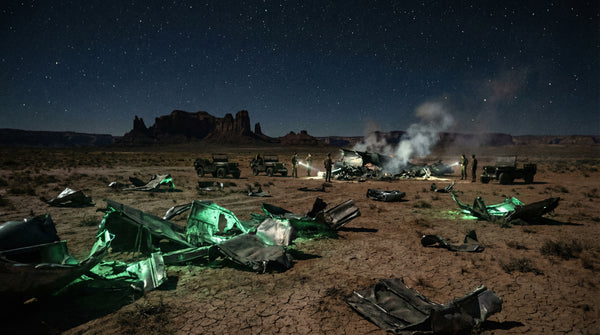
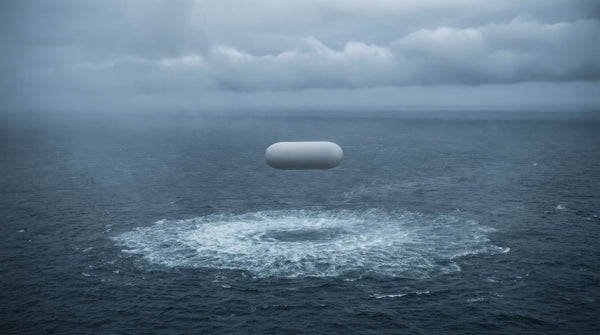
Eight months after Roswell, and roughly 350 miles to the northwest, a second craft came down in the New Mexico high desert. It was larger. It was more intact. And according to the men who said they stood over it, it still carried its crew. Within two weeks it had been cut apart, loaded onto military transporters, and driven toward Los Alamos — after which it officially never existed. This is the Aztec Incident, the crash that researchers came to call "the other Roswell."
| // KEY FACTS AT A GLANCE | |
|---|---|
| Designation | The Aztec Craft — Hart Canyon Disc |
| Date | March 25, 1948 |
| Location | Hart Canyon, ~12 miles NE of Aztec, New Mexico |
| Diameter | ~99.9 feet — the largest disc reported to that date |
| Height | ~18 feet across the upper dome |
| Construction | Seamless hull, aluminum-like alloy, no rivets, bolts, or welds |
| Portholes | Six 16-inch ports of mirror-finish glass on the dome |
| Occupants | Up to 16 humanoid bodies, 36–42 inches tall |
| First Account | Frank Scully, Behind the Flying Saucers (1950) |
| Re-Investigation | Scott & Suzanne Ramsey, The Aztec Incident (2011) |
| Status | Disputed — buried as a hoax, revived as a cover-up |
// THE MORNING OF MARCH 25, 1948
The accounts open the same way. Early light over the mesa country north of Aztec. A rancher out with his animals hears a sound wrong for the hour and looks up to see a silver disc wobbling as if hurt, scraping the face of a cliff above the Animas River in a shower of sparks before it turns hard and runs north. It comes to rest on a remote flat in Hart Canyon.
It fought to clear the cliff, clipped the corner, threw sparks and rock, then cut a right angle in midair and ran north toward the mesa. That was the last anyone saw of it in the air.
— Hart Canyon witness account, 1948
By the time oil-field workers, local police, a county commissioner, and a preacher reached the site, the craft was down and, by every description, nearly undamaged — a disc of close to 100 feet resting on the ground with no crater, no debris field, and no way in.
// A CRAFT WITH NO SEAMS
What the witnesses described did not match anything built in 1948. The hull was a single smooth skin — no rivets, no bolts, no welds, no visible seam anywhere on its surface. The metal read like aluminum but shrugged off the tools brought against it; accounts insist even diamond-tipped cutters left it unmarked. The only breach was small: a single porthole in the dome, cracked open no wider than a coin.
That coin-sized flaw is how they got in. A worker fed a length of pole through the broken port, felt it catch, and tripped a release. A hatch opened. Inside, in the dim of the cabin, were the crew — small figures, none over three-and-a-half feet, slumped where they had died. Sixteen, by the fullest count.
// THE RECOVERY
The response was fast and disciplined. Accounts place the recovery under the Air Force and elements of the 5th Army, with the errant landing said to have been tracked by an experimental radar station near El Vado built to watch over Los Alamos. Unable to move a 100-foot disc whole, the recovery team is described as cutting the hull into three equal "pie" segments and hauling them out on World War II–era M25 tank transporters. The operation ran roughly two weeks. Everything — craft and crew — was routed to Los Alamos for study, and later rumored on to Wright-Patterson in Ohio.
Then the desert was put back the way it had been found. One man who came forward decades later said his job in 1948 was not recovery but erasure: bury the debris, pull out the equipment, replant the brush, and leave Hart Canyon looking like nothing had ever touched it.
// THE HOAX THAT WOULDN'T DIE
The Aztec story reached the public through columnist Frank Scully, first in Variety and then in his 1950 bestseller Behind the Flying Saucers. His sources were two men, Silas Newton and Leo Gebauer, who were selling "doodlebug" devices they claimed used recovered alien technology to find oil. When their scheme was exposed as fraud, the Aztec case went down with them. By 1952 it had been branded a hoax, and for more than thirty years serious researchers would not touch it.
The revival came slowly. William Steinman's 1986 investigation reopened the file; Leonard Stringfield kept it alive; and beginning in the late 1980s, Scott and Suzanne Ramsey spent more than three decades, over half a million dollars, and 55,000-plus documents across 27 states rebuilding the case from the ground up. They found the "impossible" radar was real, tracked down first-hand witnesses whose accounts matched without ever having met, and argued that the con-man story was not the whole truth but the cover laid over it. In 2007 they set a plaque on the mesa. It calls what came down there, plainly, "a spacecraft of origins unknown."
From 1952 onward, no one would go near Aztec. It was considered poisoned — a hoax pushed on the public by con men. That was exactly what made it the safest thing in the world to bury.
— The Aztec re-investigation
// WHY THE AZTEC CRAFT MATTERS TO COLLECTORS
Roswell gets the headlines. Aztec is the connoisseur's crash — older in the public record, stranger in its details, and unique in that it left behind an actual engineering reconstruction. The craft on your shelf is not a generic saucer. Its form is drawn from the witness descriptions and the technical reconstruction credited to aerospace historian Michael Schratt: the seamless lens hull, the ~99.9-foot proportions, the six 16-inch dome ports, the twin domes above and below, the underside entry hatch. Every line is lore. For anyone building a serious crash-retrieval collection, the Hart Canyon disc is the piece that separates the researchers from the tourists.
// CONCLUSION
Three-quarters of a century later, Hart Canyon still keeps its secret. The con men were real. The witnesses were real. The radar was real. The disc — if it was a disc — was cut into thirds and driven into a file that has never fully opened. Believe it or don't; the case refuses to close. This replica is built to keep that question on your shelf, exactly as the accounts describe it. Made in USA.
// OWN A PIECE OF THE LORE
The disc recovered at Hart Canyon in 1948 — reconstructed from the witness accounts and the Michael Schratt files.